What is justice?
What is justice? Why do we always speak of justice when we are failing to do the simple things that would prevent its need? And what is justice worth, coming from someone who passed sentence before he knew anything?
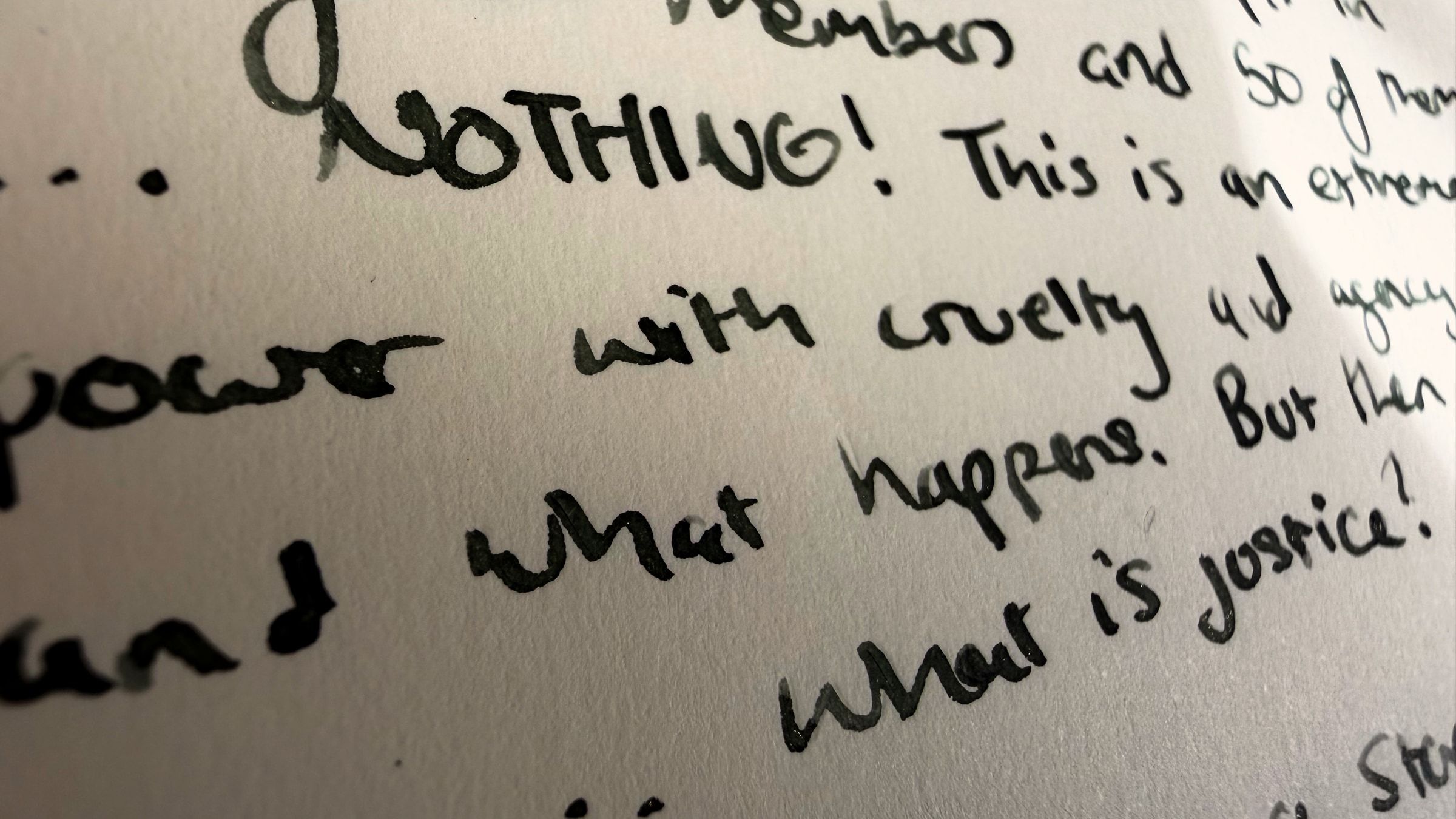
What this is for
An observation about social behaviour, and about my own. It touches the philosophy I am writing, but it is not offered as evidence for it.
I’m sure you have likely seen social media blowing up about the case at Cornell University involving a young woman and 7 young men. Well I heard and read about this and ended up writing my thoughts about in my notepad.
I had been presented with the account of a woman, gang raped by seven men over several hours. No prosecution. A university that asked them to write letters of apology and think about what they had done … THINK about what they had done. That is what I ask my five year old to do when he draws on Grannie’s wall.
Then the added bonus that they posted about it into a group WhatsApp that contained 57 people. 7 people involved. Meaning fifty who were not, but fifty who knew, and fifty who did nothing about it.
I had started writing, I had decided, completely, before I knew anything, and as it turns out before any of us outside of it actually know anything.
I asked the wrong question, and got a worse answer
Whilst writing and thinking I noticed that the incident was from 2024. The question that prompted was not a noble one. It was if this happened two years ago, why are we hearing about it now as if present fact, and what have I been reacting to so strongly?
So I went and looked. The allegations concern an event in 2024. The prosecutor at the time initially declined to bring charges based on the account at the time and the evidence then available. Rightly or wrongly (in this case) that is how the law works, the prosecutor … who remember has the job of putting guilty people behind bars … concluded that there was sufficient doubt that it was reasonable doubt to if a crime was committed. A civil case has now recently been filed. A criminal investigation has been reopened, and will go to a grand jury. So the facts are contested, and nobody has been convicted of anything … yet.
I wrote very strongly, with language that inferred guilt, and sentenced 50 others for their silence … silence I had not, and could not, verify. I did this in a short space of time, from within maybe an hour or two of first hearing about it, and what I wrote so quickly and with such vehement emotion, in less than 15 minutes.
What my own philosophy says about that
Well … the irony is not lost on me. I sit here writing and thinking about a philosophy in which kindness is one of the mechanisms that stops values inverting into their shadows, and in which kindness has a shadow of its own … not weakness … not indulgence … but condemnation. The very thing I had just done with such passion in my notebook. The kindness that has stopped seeing a person as a sovereign individual to be judged on their actual actions, but as a case to be judged by any account of those actions.
I turned 7 people into that case to be judged, and 50 more into a category to be judged as a case … long before I had actually checked the facts.
I had done the very thing I say we should be trying to avoid doing. Judge people not on the perceptions of what they do, or what they say they intended, but on the way they react to the outcomes of their actions, even the ones they did not intend. That is where someone’s true character and nature is observed.
I’m not going to try and write my way around this irony. The philosophy I am building says power should be used to protect and elevate others, and not to dominate them. Writing is a power. Having the platform to share that is a power. Certainty in public about people who cannot answer me, is the cheapest and most complete form of domination available, and I reached for it instantly.
But I will not take the anger back
So now we get into the interesting part. If all of the above is true, why am I publishing a piece on it, rather than deleting it, or ignoring that it happened (as convenient and comfortable as that would feel right now).
The condemnation, the failure to hold kindness in the face of something awful was the wrong choice of behaviour … but the anger it stirred was not wrong, and was aimed at the right thing.
The philosophy I’m writing states what happens when tension is not held. Strength without restraint becomes cruelty, agency without responsibility becomes domination. When a group normalises these inversions, the people inside that group stop seeing it at all. Harm at this scale is therefore not an aberration in a system, but the outcomes of the system itself when nobody is holding the tension in it.
And let’s face it, my anger although misdirected at the specifics of this particular case, is not misdirected at the problem in general. There is a reason my reaction was visceral, and that it immediately jumped to perceive it as fact. Group chats where everyone knows, and nobody speaks up, are real. The fifty, the majority, staying silent, are real … so in general, even though I cannot speak of anything concrete about these specific people. This cause, this root of my anger, is unfortunately very real!
So I am left holding two things that are not comfortable to co-exist … which is in itself the practice I claim to be developing, tested on myself, without my knowing, and on the evidence of it, I failed at the first attempt.
My anger is correctly aimed. My verdicts as written in my notebook were (and are) not mine to pass.
I do not get to resolve this by deciding which one “wins”. Deciding that and claiming only that happened would be a lie, and all too easy to succumb to. This is what the philosophy exists to reject, resolution between tensions. If I drop the anger, I would become a person who saw something monstrous and shrugged, because the paperwork is incomplete or “it doesn’t impact me”, or “it’s out of my control”. Keep the conviction on the verdict as written and I am doing, in miniature (and in public), the thing I claim I am objecting to.
So what is left, and it’s not nothing …
Let’s remove everything that the courts will settle, and the questions that made me pick up the pen in the first place, and in the second, are still standing.
The “fifty”. If a person knows, and says nothing, what have they done? We have no mechanism for that, and barely a vocabulary, we often wave it off as the bystander effect. They face, at most, their own guilt … and I do not think that is enough. Agency does not, and should not, switch off simply because using it would be awkward, or hard.
Punishment arrives last. Whatever happens to whoever did whatever was done, happens afterwards (obviously). But afterwards is precisely when nothing can be prevented. We spend most of our moral energy on creating, refining, and “improving” the part that comes too late to help. When the pain, the hurt, the misery, the cruelty, has already occurred.
And what am I doing about it?
It would be very easy to sit here and write a “should’a would’a could’a” piece. It would also be easy to take a moral high ground whilst failing to hold myself to the account to which I say others should.
So: I am trying to raise two boys who will not be one of “the fifty”. Who will speak up. Who will show respect. Who will not tolerate people using strength to dominate others, to coerce, to violate. Who will help others up, rather than judge them. To be tolerant of the views of others, especially when their views oppose their own … they need not agree, they need not stay silent, but they must never use their strength, their agency, their privilege, to force another.
… I do this by teaching them, and by living it, because they will learn to copy what I do long before they learn to understand what I say and why I say it.
This is a small part, a very small part in the grand scheme of the problem. But prevention is made out of small deliberate actions, and small answers, repeated. Punishment (“justice”) is made out of large ones delivered too late.
So
I wrote in my notebook in a state of complete moral clarity, and that clarity was the least reliable source to write from. It was less moral clarity, and more a sense of injustice and moral anger … it was certainly not reliable.
I am leaving the page in, photographed as it was for the header of this article, because pretending I arrived at this point calmly would be a lie.
So what is justice? I still cannot answer it.
But there is a smaller question, and one I can do something about. What is justice worth, when it comes from someone who passed a sentence before he knew anything? … the answer to that is nothing. And as this very occasion shows, I still have a long way to go in being a better human, a better member of our species. And I know that I am not alone!