Tension as the generative condition
Tension is neutral physics. Resolution produces imbalance. Health is consciously held tension.
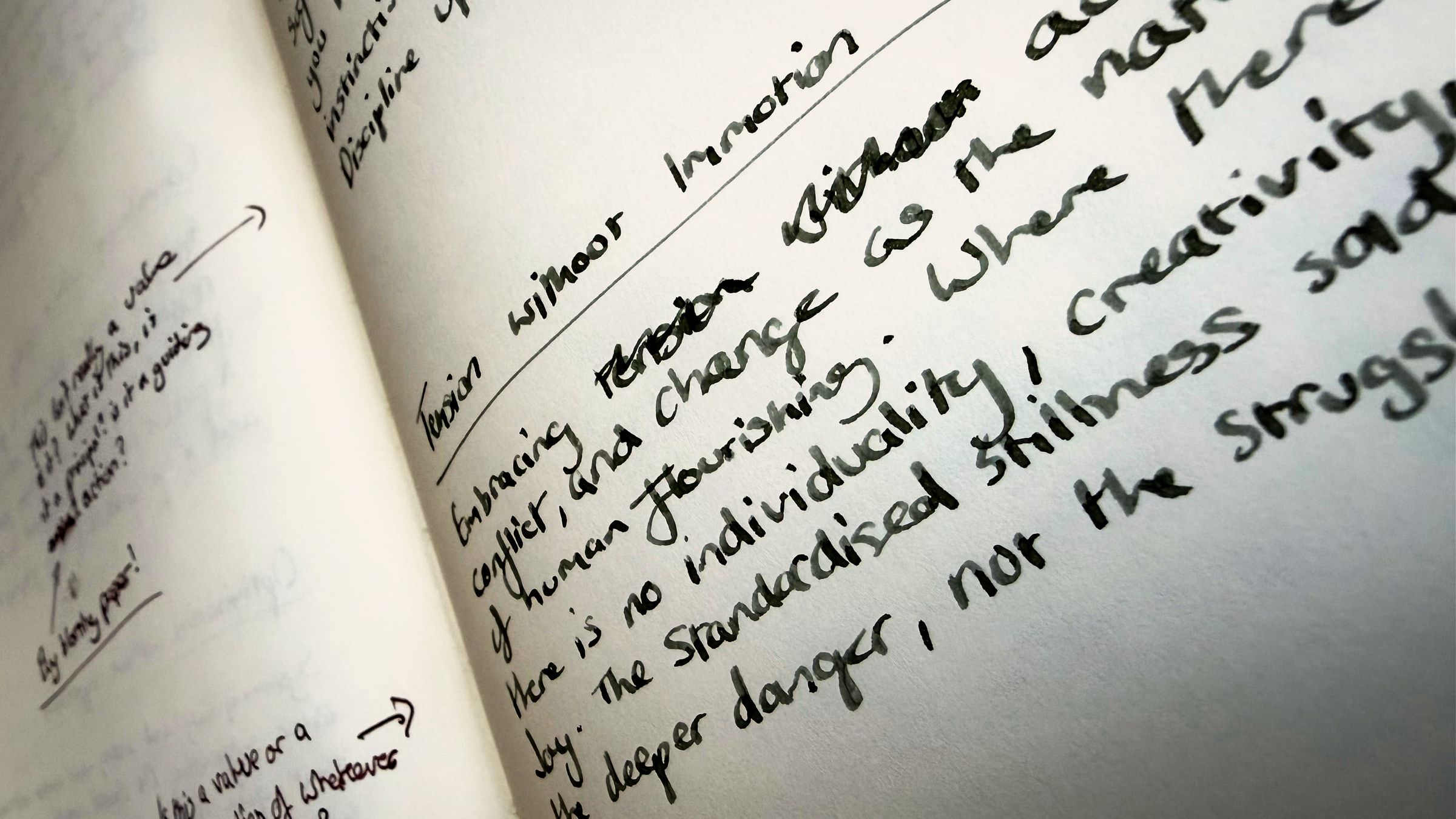
Every living system is a field of forces. A person wants rest and wants to build; an organisation wants to move fast and wants to be sure; an economy wants to reward the new and protect what already works. The common instinct (in therapy, in management, in politics) is to treat these oppositions as problems: things to be resolved, balanced, harmonised, closed.
Symmetric Sovereignty begins by rejecting that instinct.
Tension is not conflict. It is not a malfunction. It is the automatic result of real forces acting on a real system … neutral physics. A system with no tension in it is not at peace; it is either dead or has been flattened by something stronger than any of its own forces. When we “resolve” a tension we do not usually eliminate one of the forces; we suppress it, and the suppressed force does not disappear. It returns as brittleness, as resentment, as the sudden collapse of something that looked stable. Resolution produces imbalance.
Health, then (in a person, a relationship, an institution, a civilisation) is found not in resolving opposing forces but in consciously holding them. Consciously is the operative word. Tension held unconsciously is just stress. Tension held consciously is the condition under which individuality, creativity, originality, and joy actually occur (see tension without immotion).
This is why the framework refuses the vocabulary of balance. “Balance” and “symmetry” are resolution words … they smuggle in the idea of a rest state, a point at which the work of holding is done. There is no such point. The work of holding is the life.
Why this line is here
Herbert’s line, copied into the front of the notebook, is doing structural work: if understanding requires moving with a process, then any philosophy that promises to stop the process (to settle it, balance it, finish it) has misunderstood what it was looking at.
A process cannot be understood by stopping it. Understanding must move with the flow of the process, must join it and flow with it.
Frank Herbert, Dune
The notebook treats it as forces on a system. But in the values it becomes something more like two goods that can’t both be maximised. Are these the same thing? Tom to decide whether Part 1 needs a taxonomy of tensions (force-vs-force, good-vs-good, self-vs-other) or whether that is a false precision.
Part 1 needs one worked example that is not from business … a tension in a family, or in a body … to prove the claim isn’t just management philosophy in disguise.